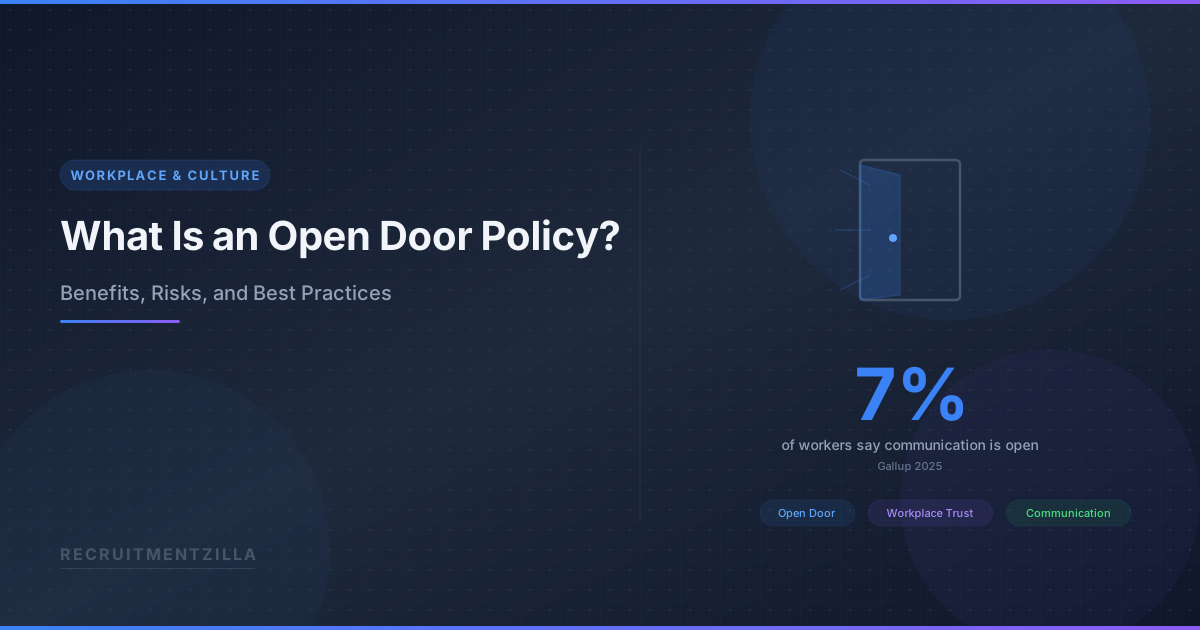
Only 7% of U.S. workers strongly agree that communication at their workplace is accurate, timely, and open (Gallup, 2025). Seven percent. That number should bother every HR professional who has ever added “open door policy” to an employee handbook and assumed the job was done.
Most organizations have some version of an open door policy. The problem isn’t the policy itself. The problem is that it rarely works the way leaders think it does. Employees still feel unheard, managers still feel overwhelmed, and complaints still go unresolved. The gap between good intentions and measurable outcomes is wide.
This guide covers what an open door policy actually is, the real benefits when it works, the risks when it doesn’t, how to implement one that survives contact with reality, and how to adapt it for remote and hybrid teams. You’ll also get a measurement framework that no other guide provides.
Key Takeaways
- An open door policy encourages employees to raise concerns, ideas, or feedback with managers or leadership without fear of retaliation.
- Workers in high-trust companies are 50% less likely to leave and 180% more motivated (Deloitte, 2024).
- Without psychological safety, the policy is decoration: 85% of employees have felt unable to raise a concern.
- Successful policies require written structure, manager training, defined channels, clear boundaries, and a closed-loop follow-up process.
What Is an Open Door Policy in the Workplace?
An open door policy is a management practice where employees can approach their supervisor, HR, or senior leadership with questions, concerns, or ideas at any time without fear of retaliation. According to SHRM, employment lawyers and HR directors consider it a necessary practice, though one that is “sometimes fluid and sometimes a point of contention.”
The scope of an open door policy goes beyond complaint resolution. It covers process feedback, innovative ideas, career development conversations, and interpersonal conflicts. In theory, it creates an accessible channel between employees and leadership. In practice, much depends on how it’s defined and enforced.
Brian Jones of Table Consulting Group puts it bluntly: “The term ‘open-door policy’ itself is so open to interpretation.” That ambiguity is the first risk. Some organizations codify their policy in writing with clear escalation paths. Others treat it as an informal cultural norm, a verbal promise made during onboarding that nobody follows up on.
What an open door policy is not matters just as much. It doesn’t replace structured feedback systems, performance reviews and self-assessments, or formal grievance procedures. It’s a supplement, not a substitute. An employee raising a harassment concern through the open door still needs access to a documented, compliance-ready process.
What Does an Open Door Policy Cover?
The typical open door policy covers work assignments, policy interpretation, innovative ideas, interpersonal conflicts, career development, and compliance concerns. Think of it as a catch-all channel for anything an employee hesitates to put in a formal request. But it’s not an invitation to gossip or a license to routinely bypass an immediate supervisor.
Yet 85% of employees have at some point felt unable to raise a concern with their manager (LinkedIn/Axcet HR Solutions, 2024). That statistic reveals the core tension. The policy exists to encourage open communication, but power dynamics, fear of retaliation, and past negative experiences make many workers reluctant to use it. When employees don’t walk through the open door, the concerns surface later in exit interview questions that reveal what your open door policy missed.
An open door policy is a workplace communication practice where employees can approach managers, HR, or senior leadership with concerns, ideas, or feedback at any time without fear of retaliation. Despite its prevalence, 85% of employees have felt unable to raise a concern with their manager (LinkedIn/Axcet HR Solutions, 2024).
What Are the Benefits of an Open Door Policy?
When executed well, open door policies deliver measurable gains in trust, retention, and performance. Workers in high-trust companies are 50% less likely to leave, 180% more likely to feel motivated, and 140% more likely to take on extra responsibilities (Deloitte, 2024). Those aren’t soft benefits. They translate directly to reduced turnover costs and higher output.
Trust and transparency form the foundation. Among leaders surveyed by Deloitte, 86% say the more transparent an organization is, the greater the workforce trust. An open door policy, when backed by consistent follow-through, signals that leadership values honesty over hierarchy. It tells employees their input matters and that raising uncomfortable topics won’t hurt their careers.
Early problem detection is another clear advantage. Issues that surface in a manager’s office at stage one don’t escalate into formal grievances, lawsuits, or surprise resignations at stage five. Every conversation that happens through the open door is a conversation that didn’t need to happen in an attorney’s office.
Employee retention follows directly. Workers in positive organizational cultures are almost 4x more likely to stay with their current employer (SHRM, 2024). Only 15% of employees in good cultures are actively job-hunting, compared to 57% in poor cultures. An open door policy contributes to culture quality when employees see that raised concerns lead to real action.
Innovation and engagement round out the picture. Employees who feel heard are 4.6x more likely to feel empowered to do their best work (Salesforce Research, 2019). That empowerment effect ripples outward: heard employees don’t just perform better individually, they contribute more ideas and take more ownership of outcomes.
Reduced legal exposure is the benefit most leaders overlook. Employers face a 12% chance of an employment lawsuit in any given year (Mosey, 2025). Documented open door conversations create a paper trail showing the organization took concerns seriously and acted in good faith. That record can be the difference between a defensible position and a costly settlement.
The Multiplier Effect of Feeling Heard
The data on feeling heard is striking. 74% of employees report being more effective at their job when they feel heard (UKG Workforce Institute, 2021). Weekly manager feedback makes employees 5.2x more likely to agree they receive meaningful feedback and 3.2x more motivated (Gallup/AIHR, 2026).
These aren’t marginal improvements. A 4.6x empowerment multiplier means the gap between organizations that listen and those that don’t is enormous. The open door policy is one mechanism for closing that gap, but only if managers are genuinely listening on the other side.
Building a culture of trust that makes internal mobility work starts with exactly this kind of accessible communication.
Open door policies drive measurable outcomes: employees who feel heard are 4.6x more empowered to perform their best work (Salesforce, 2019) and 74% more effective (UKG, 2021). Workers in high-trust companies are 50% less likely to leave and 180% more motivated (Deloitte, 2024).
What Are the Risks of an Open Door Policy?
Despite its appeal, an open door policy can backfire badly. 86% of workers feel they are not heard fairly or equally in the workplace (UKG Workforce Institute, 2021). That means the policy often creates an illusion of access that masks deeper communication failures.
Manager overload and burnout are the most immediate risks. An open door doesn’t mean “always available,” but many employees interpret it that way. Constant interruptions, emotional labor from difficult conversations, and decision fatigue pile up. Manager engagement dropped from 27% to 22% in a single year, the largest decline on record (Gallup, 2026). Asking disengaged managers to be the front line for employee concerns is asking for trouble.
We’ve seen this pattern play out repeatedly. A well-meaning VP declares the team has an open door policy, and within three months, every manager’s calendar is fragmented. What starts as fifteen-minute check-ins turns into an hour-long counseling session about a teammate conflict, followed by a career development conversation, followed by a process complaint. The manager’s own work gets pushed to evenings. The fix isn’t to close the door. It’s to define “accessible through scheduled channels” rather than “interruptible at all times.”
Bypassing the chain of command creates tension and undermines team-level accountability. When employees skip their direct supervisor and go straight to a director or VP, it signals that the immediate manager is either ineffective or untrustworthy. That dynamic damages the supervisor-employee relationship and makes the problem worse.
Lack of anonymity means sensitive issues often go unreported. Raising a concern about a manager’s behavior directly to that manager, or to that manager’s boss in a face-to-face conversation, requires a level of courage most people don’t have. Power imbalances remain regardless of what the policy says.
No paper trail is a compliance risk that HR teams underestimate. Mark Ellis, an employment lawyer quoted in SHRM, warns: “Informality can create a trap.” When open door conversations aren’t documented, organizations lose the ability to demonstrate they were aware of and responded to concerns. That gap becomes critical during compliance obligations that informal policies can miss.
A false sense of security is perhaps the most insidious risk. Having a policy on paper leads organizations to assume communication is healthy. But when raised concerns produce no visible action, trust erodes faster than if no policy existed at all. Employees stop using the door. And silence isn’t satisfaction.
Open door policies carry real risks: manager burnout from constant interruptions, bypassed chains of command, lack of documentation for compliance, and a false sense of openness when 86% of workers feel they are not heard equally (UKG, 2021). Manager engagement dropped 5 points in one year to just 22% (Gallup, 2026).
How Does Psychological Safety Make or Break an Open Door Policy?
An open door means nothing without psychological safety. Only 26% of leaders actively foster it, and just 50% of workers say their manager creates psychological safety on their team (Deloitte/Niagara Institute, 2026). Without this foundation, the open door is decoration, and employees won’t walk through it.
Amy Edmondson of Harvard Business School defines psychological safety as the shared belief that the team is safe for interpersonal risk-taking. It’s not about being nice. It’s about creating conditions where people feel they can speak up, ask questions, admit mistakes, and challenge ideas without being punished or humiliated.
The data connecting psychological safety to business outcomes is compelling. Teams with high psychological safety see 27% lower turnover, 76% more engagement, and 12% higher productivity (Gallup/Niagara Institute, 2026). Those numbers are not coincidental. When people feel safe to speak, problems surface earlier, collaboration improves, and trust compounds over time.
But here’s the question few organizations ask: if your managers themselves are disengaged, how can they possibly foster psychological safety for their teams? The connection between the manager engagement collapse (22%, down 5 points) and eroding team psychological safety isn’t just theoretical. Burned-out managers default to transactional interactions. They stop asking questions, stop following up, and stop creating space for honest conversation.
Jeff Wetzler, writing in Harvard Business Review (Oct 2025), argues that leaders should actively seek input rather than wait for employees to volunteer it. “Asking sets a powerful norm: constant learning matters more than perfection.” This feedback-seeking approach flips the open door concept on its head. Instead of waiting for someone to knock, you go out and ask.
The practical implication for HR professionals is clear. You can’t roll out an open door policy and expect results without training managers to create psychologically safe environments. Those self-assessments that require psychological safety to be honest depend on the same trust infrastructure that makes an open door policy function.
Psychological safety is the mechanism that makes open door policies work. Only 26% of leaders actively foster it, yet teams with high psychological safety see 27% lower turnover and 76% more engagement (Gallup/Niagara Institute, 2026). Without it, employees won’t use the open door regardless of what the policy says.
How Do You Implement an Open Door Policy That Works?
Implementation is where most open door policies fail. Only 13% of organizations lead in addressing trust and transparency (Deloitte, 2024). The gap between having a policy and making it effective requires five structural elements that most organizations skip.
Step 1: Write the Policy Down
A verbal promise during onboarding isn’t a policy. Write it down. Include the purpose, scope, escalation paths, confidentiality commitments, and anti-retaliation language. As SHRM notes, “It’s important not to just have a written or spoken policy, but a system in place.” Specificity matters. Name the roles employees can approach, the types of issues covered, and the follow-up timeline they should expect.
Step 2: Train Your Managers
Only 44% of managers have received formal management training (Gallup, 2025). You’re asking managers to handle sensitive conversations, maintain confidentiality, practice active listening, and know when to escalate, yet more than half of them have never been trained to do any of this. Manager training isn’t optional. It’s the difference between a policy that builds trust and one that destroys it.
The most common pattern we’ve observed is this: organizations write a beautiful open door policy, distribute it via email, and never train a single manager on how to execute it. Two designated office-hour blocks per week is a good starting point. It gives managers a defined window for open door conversations while protecting the rest of their schedule. From there, you can expand based on what the team actually needs.
Step 3: Define Communication Channels
The open door isn’t just a physical door anymore. Define the full range of channels: scheduled office hours, recurring one-on-one meetings, digital channels (Slack, Teams), and anonymous feedback options. Each channel serves a different purpose. Office hours work for quick conversations. One-on-ones handle career development. Anonymous channels capture the concerns that employees won’t attach their name to.
Step 4: Set Boundaries
Without boundaries, an open door policy becomes a revolving door. Define acceptable topics, designate specific open-door hours, and set expectations for follow-up timelines. Boundaries aren’t restrictions. They’re guardrails that make the policy sustainable for managers and predictable for employees.
Step 5: Close the Loop
This step is where 63% of the problem lives. That’s the percentage of employees considering leaving who cite poor internal communication as a factor (Staffbase, 2025). Listening isn’t enough. You need to document conversations, at minimum the themes and follow-up actions. Report aggregate trends to leadership. And act on what you hear. If employees raise concerns and nothing changes, they stop raising concerns. Then they leave.
Open Door Policy Template Elements
A well-structured open door policy document should include:
- Purpose statement: Why the policy exists and what it aims to accomplish
- Who employees can approach: Direct supervisors, HR, senior leadership, and for what types of issues
- Communication methods: In-person, virtual, and anonymous options
- Confidentiality and anti-retaliation commitments: Clear language protecting employees who use the policy
- Escalation process: What happens when a concern needs to move up the chain
- Follow-up timeline expectations: When employees can expect a response or update
The key is onboarding managers into their communication responsibilities from day one, not retroactively after a trust breakdown.
Effective open door policies require five structural elements: a written policy, manager training, defined communication channels, clear boundaries, and a closed-loop follow-up process. Only 13% of organizations currently lead in trust and transparency practices (Deloitte, 2024), and 63% of employees considering leaving cite poor internal communication (Staffbase, 2025).
How Do You Adapt an Open Door Policy for Remote and Hybrid Teams?
53% of remote-capable workers now operate on a hybrid schedule (Gallup, 2025). The literal “open door” metaphor breaks down when there’s no physical door to open. Yet the need for accessible communication is even greater in distributed settings, where informal hallway conversations and social cues vanish.
The risk compounds for frontline workers. Only 9% of non-desk employees report being very satisfied with internal communication quality (Staffbase, 2025). That satisfaction gap means the employees with the least access to leadership are also the least likely to feel heard.
Virtual office hours replace the literal open door. Dedicate weekly blocks, perhaps two 30-minute sessions, for drop-in conversations. Use Slack huddles, Zoom rooms, or Teams calls. The key is consistency. If you schedule virtual office hours, show up.
Async options address the timezone problem. Anonymous digital suggestion boxes, pulse surveys, and persistent chat channels allow employees to raise concerns on their own schedule. Not everything needs a live conversation, and some topics are easier to put in writing.
Skip-level meetings on a schedule provide structural transparency. Quarterly or bi-monthly meetings where employees meet their manager’s manager create a deliberate, non-threatening bypass that doesn’t undermine direct supervisors the way ad-hoc escalation does.
Digital availability signals help employees know when the door is “open.” Slack status updates, shared calendar blocks, and explicit “available for quick questions” windows replace the visual cue of a literally open office door.
63% of employees who consider leaving cite poor internal communication as a contributing factor (Staffbase, 2025). In distributed teams, that risk is amplified because informal communication channels disappear entirely. Understanding the communication challenges that return-to-office mandates create gives context to why hybrid open door policies need such deliberate design.
Digital Open Door Toolkit
- Synchronous: Virtual office hours, video one-on-ones, drop-in Slack channels
- Asynchronous: Anonymous surveys, feedback portals, shared Q&A documents
- Structured: Skip-level meetings, town halls, “ask me anything” sessions
Adapting an open door policy for remote and hybrid teams requires virtual office hours, asynchronous feedback channels, skip-level meetings, and digital availability signals. Only 9% of non-desk workers are very satisfied with internal communication quality (Staffbase, 2025), making intentional digital communication design essential.
How Do You Measure Whether Your Open Door Policy Is Working?
Without KPIs, an open door policy is just a platitude. The gap between 86% of leaders who value transparency and the 13% who actually lead in it (Deloitte, 2024) exists precisely because organizations don’t measure communication effectiveness. Measurement turns a well-meaning promise into a managed program.
Leading indicators tell you whether the policy is creating the conditions for open communication. Track engagement survey scores on specific questions: “My manager listens to my concerns,” “I feel comfortable raising issues,” “I trust leadership to act on feedback.” These forward-looking metrics signal problems before they hit the bottom line.
Lagging indicators confirm the downstream impact. Turnover rate trends, exit interview themes, formal grievance volume, and EEOC charge rates all reflect whether communication channels are functioning. If exit interviews consistently surface “I didn’t feel heard” themes, your open door policy isn’t working, regardless of what the handbook says.
Operational metrics give you granular visibility. Track the number of open door conversations logged per quarter. Watch for repeat-issue frequency: if the same problem keeps surfacing, it means you’re hearing concerns but not resolving them. Measure time from concern raised to resolution. Track escalation rates.
Here’s the trap many HR teams fall into: they count the absence of complaints as success. Silence doesn’t mean satisfaction. We’ve found that declining conversation volume is more often a sign of eroded trust than of resolved problems. When employees stop using the open door, it’s usually because they tried it once, nothing changed, and they gave up. The real signal is whether the same problems keep surfacing in exit interviews.
Benchmark against reality. Compare your internal survey scores against Gallup’s 7% open communication baseline (Gallup, 2025). If your scores are above that, you’re ahead of most organizations. If not, the policy needs structural changes.
Red flag signals to watch: declining conversation volume (not fewer problems, just fewer reports), rising exit interview complaints about communication, same issues surfacing repeatedly without resolution, and managers avoiding open-door sessions.
For deeper insight into what departing employees reveal about your communication culture, exit interview questions that reveal what your open door policy missed is a practical complement to this measurement framework.
Measure open door policy effectiveness through engagement survey scores, exit interview themes, conversation volume, repeat-issue frequency, and resolution speed. Compare against Gallup’s baseline: only 7% of workers say workplace communication is open and accurate (Gallup, 2025). The gap between policy intent and measured outcomes tells you whether your open door is functional or performative.
What Are the Best Alternatives and Complements to an Open Door Policy?
An open door policy works best as one channel in a multi-channel communication system, not as the only channel. When leadership communication about vision is “very clear,” 89% of employees report being happy in their roles, compared to just 25% when messaging is unclear (Staffbase, 2025). The open door can’t carry that load alone.
Regular one-on-ones remove the burden of “walking through the door.” Structured, recurring meetings create predictable space for conversation without requiring employees to initiate. Weekly feedback makes employees 3.2x more motivated and 5.2x more likely to agree they receive meaningful feedback (Gallup/AIHR, 2026). That’s a stronger foundation than any open door policy.
Anonymous feedback channels address the anonymity gap. Surveys, hotlines, and digital suggestion boxes capture the concerns that employees won’t raise with their name attached. These channels are essential for sensitive topics: management behavior, compensation fairness, and harassment. No open door policy, however well-designed, can fully replace the safety of anonymity.
Skip-level meetings provide structural transparency. Quarterly meetings between employees and their manager’s manager create a deliberate, sanctioned bypass. Unlike ad-hoc escalation (which undermines direct supervisors), scheduled skip-levels are expected and normalized.
Town halls and AMAs address organization-wide concerns at scale. When leadership communicates transparently about strategy, finances, and direction, individual open door conversations become less necessary for information-seeking and more focused on specific concerns.
Peer advocacy and ombudsperson programs offer neutral third parties who can raise concerns on an employee’s behalf. For employees intimidated by hierarchy, having someone who can advocate without the power dynamics of a direct manager-employee conversation is invaluable.
Proactive ask-first culture flips the dynamic entirely. Rather than waiting for employees to walk through the door, leaders actively solicit feedback. Jeff Wetzler, writing in HBR, notes that “feedback-seeking correlates strongly with task performance.” The best open door policies don’t wait for the knock.
Building succession planning that depends on honest upward feedback requires exactly this kind of multi-channel communication infrastructure. A single open door policy can’t surface the candid assessments needed to identify and develop future leaders.
The organizations with the strongest communication cultures don’t rely on any single mechanism. They build redundancy. An employee might skip the open door but respond to an anonymous pulse survey. A manager might miss something in a one-on-one but catch it in a skip-level report. The goal isn’t perfecting one channel. The goal is making it unlikely that a serious concern goes completely unheard.
The most effective organizations pair open door policies with regular one-on-ones, anonymous feedback channels, skip-level meetings, and a proactive ask-first culture. Weekly manager feedback alone makes employees 3.2x more motivated and 5.2x more likely to receive meaningful feedback (Gallup/AIHR, 2026). Multi-channel communication creates the redundancy that catches concerns before they become attrition.
Frequently Asked Questions
Is an open door policy legally required?
No federal law mandates an open door policy. It’s a voluntary practice. However, having one helps demonstrate good-faith efforts to address workplace concerns, which can reduce legal exposure. Employers face a 12% chance of an employment lawsuit in any given year (Mosey, 2025). A documented open door process shows regulators and courts that the organization took employee concerns seriously.
Can an open door policy replace a formal grievance procedure?
No. An open door policy supplements formal processes. It doesn’t replace them. Harassment, discrimination, and compliance issues require documented grievance procedures with defined investigation steps, timelines, and protections. SHRM recommends maintaining both: the open door for informal, early-stage concerns and a structured grievance process for issues that require formal investigation and resolution.
How do you prevent an open door policy from overwhelming managers?
Set designated office hours rather than offering unlimited access. Train managers on when to redirect versus resolve. Establish escalation paths so managers aren’t handling every issue alone. Use async channels for non-urgent matters. Start with two weekly blocks and adjust based on demand. The goal is “always accessible,” not “always interruptible.”
What should you do when an employee raises a concern through the open door?
Listen actively without interrupting or becoming defensive. Document the key themes and agreed-upon follow-up actions, even informally. Set a clear timeline for resolution or next steps. Close the loop: follow up by the date you committed to, even if the answer is “we’re still working on it.” The worst outcome is silence after a conversation.
Does an open door policy work in remote or hybrid settings?
Yes, but it requires deliberate adaptation. Virtual office hours, asynchronous feedback channels, digital availability signals, and scheduled skip-level meetings replace the physical open door. With 53% of remote-capable workers in hybrid arrangements (Gallup, 2025), the policy needs to function across multiple work modes. Written guidance on which channels to use for which types of concerns prevents confusion.
Conclusion
The 7% reality is hard to ignore. Nearly all organizations claim to value open communication. Nearly none deliver it effectively. An open door policy is necessary, but it is not sufficient. It requires psychological safety, manager training, a written structure, measurement against real KPIs, and complementary channels that create communication redundancy.
The difference between a policy that sits in a handbook and one that reduces turnover and builds trust comes down to execution. Do your managers know how to listen? Do they have time to? Does anything change when concerns surface? If you can’t answer yes to all three, the door might be open, but nobody’s walking through it.
Start with the five-step implementation framework from this guide. Measure within 90 days. Adjust based on what the data, not your assumptions, tells you. The organizations closing the gap between 7% and meaningful open communication aren’t the ones with the most eloquent policies. They’re the ones that follow through.