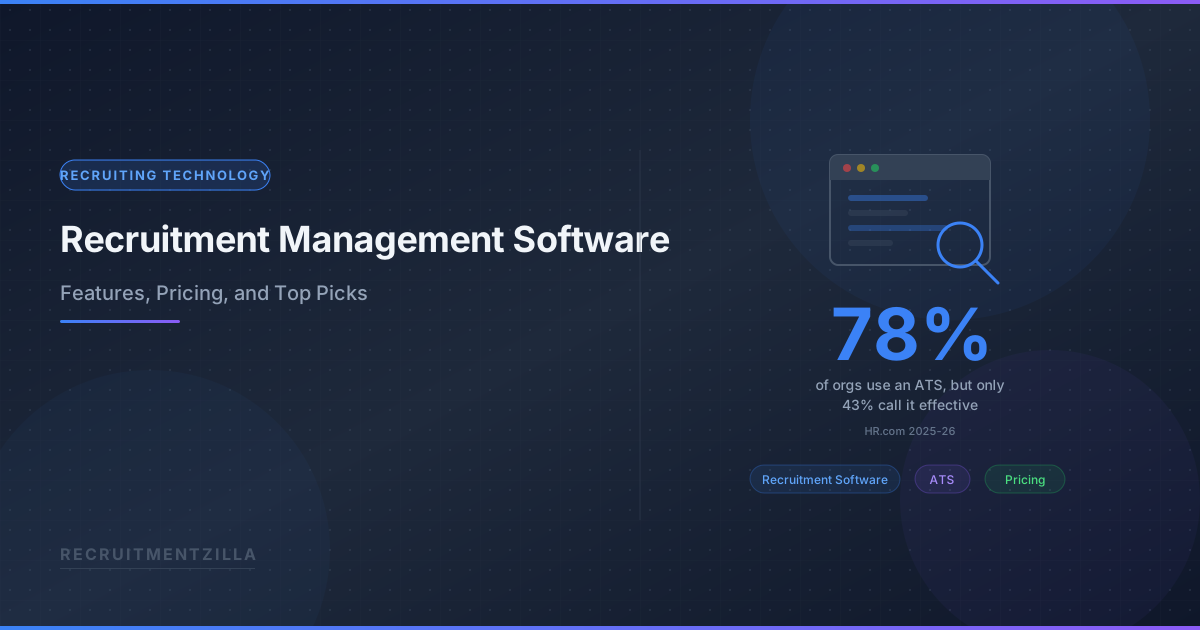
Seventy-eight percent of organizations now use an applicant tracking system, yet only 43% rate their talent acquisition tech stack as “good” or “excellent” (HR.com, 2025). That gap between adoption and satisfaction tells a clear story: most teams own recruitment software, but the wrong recruitment software.
Some teams outgrow their tools within a year. Others pay for features they’ll never touch. And a surprising number still treat a basic ATS as a complete solution when they actually need a full recruitment management platform. The mismatch costs real money and real time.
This guide breaks down what recruitment management software actually does, which features separate useful platforms from expensive shelf-ware, real pricing across eight tiers, and our top picks for 2026. You’ll leave with a decision framework and a demo checklist you can use this week.
Key Takeaways
- The recruitment management software market will grow from $3.41B to $7.48B by 2034 (Fortune Business Insights, 2025)
- 79% of organizations already integrate AI or automation into their ATS
- Free tiers from multiple vendors now offer enterprise-grade core features
- Average cost-per-hire is $5,475; the right platform can cut hiring cycles by up to 60%
What Is Recruitment Management Software?
Only 21% of organizations use a standalone CRM alongside their ATS (HR.com, 2025). That leaves most hiring teams without passive-candidate nurturing or end-to-end pipeline visibility. Recruitment management software solves this by combining applicant tracking, candidate relationship management, automation, and analytics into a single platform.
Think of it as three layers working together. An ATS tracks applicants through pipeline stages, from application to offer. A CRM nurtures passive talent before they ever apply. A recruitment management system wraps both layers together and adds workflow automation, analytics, and orchestration on top.
Why does the distinction matter? Consider that roughly 70% of the global workforce is passive, meaning they’re not actively applying to jobs. A standalone ATS can’t reach those people. It can’t build talent pools, run nurture campaigns, or tell you which sourcing channels produce your best hires. It just tracks the candidates who already showed up.
The evolution has been steady. Teams moved from spreadsheets to standalone ATS platforms in the 2010s. Then CRMs entered the picture. Now, integrated recruitment management systems are replacing the patchwork. If you want to understand how applicant tracking systems work at a granular level, we’ve covered that separately. Here, we’re focused on the broader platform category.
Citation capsule: Recruitment management software integrates applicant tracking, candidate relationship management, workflow automation, and analytics into a single hiring platform. While 78% of organizations use an ATS, only 21% pair it with a CRM (HR.com, 2025), leaving the majority without passive-candidate nurturing or end-to-end visibility.
What Features Should You Look For in Recruitment Management Software?
Ninety-four percent of recruiters say their ATS has had a positive impact on hiring outcomes (Select Software Reviews, 2026). But the gap between satisfied and frustrated users often comes down to one thing: whether the platform automates the repetitive tasks that consume a recruiter’s day. The flashiest AI tools don’t matter if scheduling still requires twelve emails.
Here’s what should be on your must-have list:
| Feature Category | What It Does | Why It Matters |
|---|---|---|
| Job posting distribution | Syndicates openings to multiple boards at once | Reduces manual posting to one click |
| Resume parsing and screening | Extracts candidate data and ranks by fit | Eliminates initial manual review |
| Interview scheduling | Calendar sync and automated coordination | Saves 2-10 hours per week |
| Pipeline automation | Moves candidates through stages with triggers | Keeps your process consistent |
| Collaborative hiring | Scorecards, feedback loops, approval workflows | Aligns hiring managers and recruiters |
| Reporting and analytics | Tracks time-to-hire, source quality, funnel metrics | Turns gut feel into data |
| Compliance tools | EEOC, GDPR, OFCCP tracking and reporting | Prevents costly violations |
Beyond the essentials, a few nice-to-haves are worth evaluating: built-in CRM and talent pool management, programmatic job advertising, video interview integration, and onboarding handoff capabilities. But don’t pay for them if you won’t use them within six months.
Why AI Features Are Becoming Table Stakes
Seventy-nine percent of organizations have already integrated AI or automation directly into their ATS (Select Software Reviews, 2026). And 85% of HR leaders say AI capabilities will influence their next software purchase (Capterra, 2025). So what’s AI actually doing inside these platforms?
The answer might surprise you. The most common AI use case isn’t autonomous candidate screening. It’s creating interview questions (67%), followed by writing job descriptions (65%), resume filtering (44%), and candidate communications (43%). For the complete guide to AI in recruitment, including how to separate genuine capability from marketing fluff, we’ve written a dedicated resource.
Citation capsule: The most impactful recruitment software features are workflow automation, scheduling integration, and analytics, not AI alone. However, 79% of organizations have already integrated AI into their ATS, and 85% of HR leaders say AI capabilities will influence their next purchase decision (Capterra, 2025).
How Much Does Recruitment Management Software Cost?
Recruitment software pricing spans from $0 to over $1,000 per month, but the median mid-market platform falls between $100 and $300 per month (Select Software Reviews, 2026). The average cost-per-hire is $5,475 (SHRM, 2025), so the math on software investment usually works out fast.
Here’s what the pricing landscape actually looks like:
| Tier | Platform Examples | Starting Price |
|---|---|---|
| Free | Pin (free plan), Zoho Recruit (free), Breezy HR (Bootstrap) | $0/mo |
| Starter | Manatal ($15), Zoho Recruit paid ($25), JazzHR ($75) | $15-$75/mo |
| Mid-market | BambooHR ($99), SmartRecruiters ($100), Workable ($299) | $99-$299/mo |
| Enterprise | Greenhouse ($500), VidCruiter ($1,000), iCIMS/Workday (custom) | $500-$1,000+/mo |
Common pricing models include per-user, per-job, flat-rate, tiered bundles, and custom enterprise contracts. Each has trade-offs. Per-job pricing works for low-volume teams but punishes growth. Per-user pricing is predictable but expensive for large TA teams. Flat-rate models offer simplicity, though you may pay for capacity you don’t need.
In our experience evaluating recruitment platforms, the sticker price is rarely the full cost. Implementation fees, per-seat overages, and premium integration charges can add 30-50% to what you see on the pricing page. Ask specifically about data migration costs, API access fees, and per-job-post charges before you sign anything.
How to Calculate Your True Recruitment Software ROI
Most vendors talk about ROI in vague terms. Here’s an actual formula you can run with your numbers:
ROI = (Reduction in cost-per-hire x annual hires) + (Time saved x recruiter hourly cost) - Annual software cost
With average cost-per-hire at $5,475, even a 20% reduction across 50 annual hires saves $54,750. An effective ATS decreases the hiring cycle by up to 60% (Select Software Reviews, 2026). Recruiters using AI tools save roughly 20% of their workweek (LinkedIn, 2025). Factor those time savings at your team’s hourly rate, subtract your annual platform cost, and you’ll have a defensible number to bring to your CFO.
For a deeper look at the cost side of the equation, see how to calculate and benchmark your cost per hire.
Citation capsule: Recruitment management software pricing ranges from free to $1,000+ per month. The average cost-per-hire is $5,475 (SHRM, 2025), so even a modest efficiency gain from the right platform can deliver significant ROI, with effective ATS platforms reducing hiring cycles by up to 60%.
Which Recruitment Management Platforms Lead in 2026?
The recruitment software market hit $3.41 billion in 2025 and is growing at 8.95% CAGR (Fortune Business Insights, 2025). That growth means more choices than ever, but also more noise. We narrowed the field to platforms that combine ATS, CRM, automation, and analytics in a single system.
Here are the recruitment management software platforms that stood out across our evaluation criteria of database size, AI accuracy, pricing accessibility, time-to-fill data, recruiter productivity, and user ratings.
Pin offers AI-powered sourcing backed by 850M+ candidate profiles, the largest proprietary database in the category. Users report a 14-day average time-to-fill, an 83% candidate acceptance rate, and 12 hours saved per recruiter per week. It carries a 4.8/5 G2 rating with a free tier plus paid plans from $100-$249/month. The limitation: it’s a newer entrant with a smaller partner ecosystem than legacy players.
We ran a side-by-side test sourcing mid-level marketing candidates. Pin surfaced 3x more qualified profiles than LinkedIn Recruiter Lite in half the time, largely because of that massive profile database. The accuracy of its AI matching was noticeably stronger on roles where skills mattered more than job titles.
Greenhouse is the industry standard for structured hiring. Users see 27% faster time-to-hire, and the platform supports 400+ integrations with deep DE&I tools. Starting at approximately $500/month with no free tier, it’s built for mid-market and enterprise teams willing to invest in process rigor. The limitation: the price tag locks out smaller teams.
Workable takes a mobile-first approach and serves 30,000+ companies globally. Forbes Advisor named it the best AI-powered recruiting platform in 2024. It’s a strong mid-market option, though advanced features sit behind the Premier tier. Budget-conscious teams may find the jump from Standard to Premier steep.
JazzHR is the go-to for SMBs at $75/month. It delivers straightforward ATS functionality with job posting syndication, keeping things simple. The trade-off: light analytics and minimal AI capabilities. If you’re hiring fewer than 10 people a month and want simplicity, it does the job.
Zoho Recruit boasts the strongest free tier in the market and scales to enterprise at $90/month. Teams already in the Zoho ecosystem will appreciate the native integrations. The limitation: UI complexity grows as you enable more modules.
Bullhorn dominates the staffing and agency segment with AI-powered automation and advanced analytics. Pricing sits at the enterprise level with a steeper learning curve, but agencies handling high-volume placements find it indispensable.
For our full recruiting software rankings covering both agency and in-house use cases, we’ve published a separate deep-dive comparison.
Citation capsule: The recruitment software market reached $3.41 billion in 2025 (Fortune Business Insights, 2025). Leading platforms like Pin (850M+ profiles, 14-day time-to-fill, free tier), Greenhouse (400+ integrations), and Workable (30K+ customers) combine ATS, CRM, and AI, but the best fit depends on team size, budget, and hiring volume.
How Do You Choose the Right Platform for Your Team?
Only 43% of organizations rate their TA technology as effective (HR.com, 2025), and a major reason is buying the wrong tool for the context. Over 80% of candidates who experience poor communication during recruitment take at least one negative action against the employer (Capterra, 2025). Your platform choice affects both recruiter efficiency and candidate perception.
Start with your team size and hiring volume. The right platform for a solo recruiter filling five roles a month looks nothing like what a 50-person TA team needs.
Solo recruiter or startup (1-10 hires/month): Prioritize free tiers, ease of use, and broad job posting reach. You don’t need enterprise-grade analytics yet. Pin’s free plan, Zoho Recruit, or Breezy HR will cover the essentials without a budget hit.
Mid-market team (10-50 hires/month): Workflow automation, deep integrations with your HRIS and calendar, and reporting dashboards become critical. Look at Workable, SmartRecruiters, or Pin’s paid tiers.
Enterprise or agency (50+ hires/month): Scalability, AI-powered sourcing, compliance tools, and API access are non-negotiable. Greenhouse, Bullhorn, or Pin’s enterprise plan fit here.
The most expensive mistake we see teams make is buying the most feature-rich platform when they need the simplest one. A solo recruiter doesn’t need a tool built for 50-person TA teams. The unused complexity will slow them down.
Beyond team size, evaluate every platform against five criteria: integration depth (HRIS, calendar, background checks), AI capability maturity, pricing model alignment, analytics granularity, and candidate experience quality. That last one matters more than most teams realize. If you’re looking for quick wins, here are eight recruiting tasks you should automate today.
The Demo Checklist: What to Test Before You Buy
Don’t just watch a vendor’s polished walkthrough. Run your own evaluation:
- Process a real requisition end-to-end through the system
- Test the candidate-facing experience on mobile, because that’s how most applicants apply
- Ask for benchmarks on time-to-hire and adoption rates from similar-sized customers
- Check integration depth with your current HRIS, calendar, and video platform
- Verify compliance features, including EEOC reporting and data retention policies
If the vendor can’t support any of these tests during a demo, that tells you something about the product’s maturity.
Citation capsule: Only 43% of organizations rate their recruitment technology as effective (HR.com, 2025). To avoid joining the majority, evaluate platforms against five criteria: integration depth, AI maturity, pricing alignment, analytics granularity, and candidate experience. Always run a real requisition through the system before committing.
What Role Does AI Play in Modern Recruitment Software?
AI adoption in recruitment has nearly doubled in two years. Organizations not using AI dropped from 73% in 2023 to just 37% in 2025 (HR.com, 2025). But the way AI is deployed varies wildly, and marketing claims don’t always match reality. The top use case is generating interview questions (67%), not the autonomous screening that headlines suggest.
So what is AI actually doing inside recruitment platforms today? Here’s the real map.
AI-powered sourcing searches candidate databases, ranks profiles by fit, and surfaces passive talent. Pin’s approach, drawing from 850M+ profiles with an 83% candidate acceptance rate, represents the high end. Most platforms offer some version of this, though database size and matching accuracy vary enormously.
AI-powered screening handles resume parsing, skills matching, and knockout criteria. Sixty-four percent of organizations use AI to filter unqualified candidates (Select Software Reviews, 2026). This is where the time savings are clearest, with recruiters saving roughly 20% of their workweek through automation (LinkedIn, 2025).
AI-powered scheduling automates interview coordination, eliminating the back-and-forth that drains recruiter hours. We’ve found that this single feature often delivers the most immediately noticeable productivity gain.
AI-powered analytics can predict time-to-fill, flag pipeline bottlenecks, and surface quality-of-hire signals. This is the least mature category, but it’s evolving fast.
What about the risks? Fifty-eight percent of organizations cite bias risk as their top AI concern. And Gartner predicts that 75% of hiring processes will include AI proficiency certifications by 2027. If your platform uses AI for screening or ranking decisions, you need transparency into how those decisions are made. For a practical walkthrough, read how to audit your recruitment AI for bias.
Citation capsule: AI adoption in recruitment nearly doubled between 2023 and 2025, with non-users dropping from 73% to 37% (HR.com, 2025). The most common AI applications are generating interview questions (67%) and writing job descriptions (65%), while 58% of organizations cite bias risk as their top AI concern.
How Is the Recruitment Software Market Changing in 2026?
Fifty-nine percent of organizations plan to increase their investment in TA technology this year (HR.com, 2025), and the market is projected to nearly double from $3.41 billion to $7.48 billion by 2034 (Fortune Business Insights, 2025). Three forces are reshaping what buyers should expect from their next platform.
Market Consolidation Is Accelerating
The Monster and CareerBuilder merger made headlines, and Bullhorn’s acquisition of Textkernel signaled a broader pattern. Standalone ATS tools are getting absorbed into integrated suites. For buyers, this means your current vendor might look very different in 18 months. Prioritize platforms with strong independent roadmaps and financial stability.
Quality Over Volume Is the New Priority
As Gartner’s Jamie Kohn puts it: “Companies have more applicants, but not quality applicants” (HR Dive, 2026). AI-generated resumes and mass-apply bots like LazyApply and LoopCV are flooding inboxes. Modern recruitment platforms need better signal-to-noise filtering, and that’s driving demand for AI screening that goes beyond keyword matching. Are your current tools equipped to handle this shift?
SMB Access to Enterprise Features Is Expanding
Free tiers from Pin, Zoho, and Breezy HR have brought enterprise-grade capabilities to startups. The pricing floor has dropped while the capability floor has risen. A five-person company can now access AI sourcing, pipeline automation, and analytics that cost six figures a decade ago. The real differentiator isn’t budget anymore. It’s implementation quality.
Skills-Based Hiring Is Entering the Platform
Platforms are adding skills assessments, certification verification, and what Gartner calls “AI-free” testing zones. The shift toward evaluating what candidates can do, rather than where they’ve worked, is influencing how recruitment management software handles screening and ranking.
What does all this mean for buyers? Invest in platforms that can grow with you and won’t be acquired into irrelevance. For our data-backed predictions for recruiting in 2027, including which trends will stick, we’ve published a detailed forecast.
Citation capsule: The recruitment software market is projected to grow from $3.41 billion to $7.48 billion by 2034 (Fortune Business Insights, 2025). Three forces are driving change: vendor consolidation (Monster-CareerBuilder, Bullhorn-Textkernel), quality-over-volume hiring as AI-generated applications surge, and free tiers that give SMBs access to enterprise-grade tools.
Frequently Asked Questions
What is the difference between recruitment management software and an ATS?
An ATS tracks applicants through pipeline stages. Recruitment management software bundles the ATS with CRM, sourcing automation, analytics, and workflow tools into one platform. While 78% of organizations use an ATS, only 21% also use a CRM (HR.com, 2025). A full recruitment management system closes that gap.
How much does recruitment management software cost for a small business?
Free tiers are available from Pin, Zoho Recruit, and Breezy HR. Paid plans for small teams start at $15 per month with Manatal and typically run $75-$100/month for full ATS functionality. Hidden costs like implementation fees and per-job charges can add 30-50% on top, so ask for a total-cost breakdown before committing.
Can recruitment management software reduce time-to-hire?
Yes. An effective platform can decrease the hiring cycle by up to 60% (Select Software Reviews, 2026). Pin reports a 14-day average time-to-fill, and Greenhouse users see 27% faster time-to-hire. The biggest gains come from automating scheduling, screening, and candidate communication.
Is AI in recruitment software safe from bias?
Not automatically. Fifty-eight percent of organizations cite bias risk as their top AI concern (HR.com, 2025). Look for platforms that offer bias auditing, explainable AI decisions, and EEOC-compliant reporting. Regular audits and human oversight are non-negotiable.
What is the average ROI of recruitment software?
With average cost-per-hire at $5,475 (SHRM, 2025), even a 20% reduction across 50 annual hires saves $54,750, far exceeding most platform costs. Recruiters also save up to 20% of their workweek through AI-powered automation (LinkedIn, 2025).
Conclusion
Recruitment management software isn’t just a bigger ATS. It’s the difference between tracking candidates and actually managing a hiring operation. The core distinction, ATS versus CRM versus full RMS, determines whether your team can source passive talent, automate repetitive work, and measure what’s actually working.
The 43% satisfaction rate exists because most teams buy the wrong tool. Use the decision framework above: match your team size and hiring volume to the right recruitment management software tier, evaluate against the five criteria, and run the demo checklist with your actual workflows before signing anything.
Pin earns our top recommendation for teams that want AI-powered sourcing backed by the largest candidate database and an accessible pricing model. But the best platform for you depends on your specific context. Start with the pricing table, run demos with real requisitions, and prioritize the tool that improves both recruiter productivity and candidate experience.